By Staff Reporter
In the international background screening industry, global consumer reporting agencies (CRAs) rely heavily on data vendors to navigate complex, highly fragmented foreign judicial systems. However, a growing trend among low-tier aggregators is to compress multi-tiered, jurisdiction-specific legal processes into generic, one-line spreadsheet summaries.
When a screening provider or data vendor relies on oversimplified, flat-fee coverage matrices, it often masks critical operational gaps—exposing CRAs to severe FCRA compliance risks, missed criminal records, and inaccurate turnaround expectations.
An examination of standard industry templates exposes several immediate warning signs that indicate a vendor is selling generic summaries rather than executing genuine ground-truth research.
1. Vague, Boilerplate "Source" Descriptions
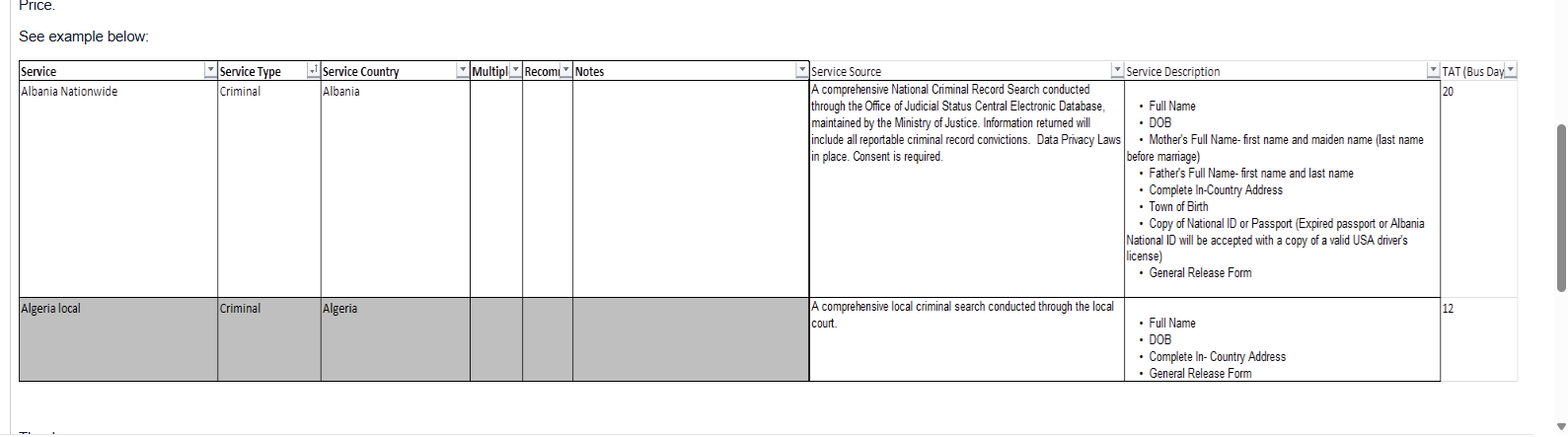
Look closely at how sources are defined in typical vendor spreadsheets:
- The "Algeria" Example: Listing the service source simply as "A comprehensive local criminal search conducted through the local court" is a massive red flag. Which local court? Is it a court of first instance, a regional tribunal, or an administrative magistrate?
- The "Albania" Example: Citing a "comprehensive National Criminal Record Search conducted through the Office of Judicial Status Central Electronic Database" creates a false sense of coverage.
The Risk: Generic descriptions usually mean the vendor is relying on secondary database scrapes, outdated commercial indexes, or an unverified middleman who cannot confirm whether the search was actually conducted at the primary court repository.
2. Inconsistent and Conflicting Identifier Requirements
A dead giveaway of a flawed vendor matrix is a mismatch between the reported "search depth" and the intake requirements requested from the applicant.
In standard templates, a vendor might list a simple, two-word source description for one country while dumping an exhaustive, chaotic list of required documents into another text box:
- Requiring a candidate's mother’s maiden name, father’s full name, town of birth, complete in-country physical address, national ID/passport copy, and driver's license for a basic check indicates a total lack of structural intake rules.
The Risk: Primary court registries across different jurisdictions have strict, specific matching criteria. When a vendor asks for everything under the sun in a generic text box without explaining why (e.g., whether parental names are legally required by the court clerk to disambiguate common regional surnames), they are often throwing candidate data at a wall to see what sticks.
3. Oversimplified "Blanket" Turnaround Times (TAT)
In primary-source international court research, turnaround times are rarely uniform across an entire country. Local court dockets, physical archive retrievals, clerk availability, and regional holiday calendars directly dictate how fast a record can be pulled and abstracted.
When a vendor lists a flat, fixed turnaround time (such as 12 days or 20 business days) for a whole nation:
- They are either setting arbitrary expectations that fail in practice.
- Or they are using an automated, high-level database query that completely bypasses actual physical court dockets.
The Risk: Real court record retrieval in municipal or regional trial courts fluctuates. Vendors claiming rigid, static turnarounds across diverse municipalities are often hiding delays caused by multi-layered broker networks.
What Primary-Source Coverage Should Actually Look Like
To protect candidates and ensure FCRA/GDPR compliance, CRAs must demand complete transparency from their international vendors. A legitimate ground-truth retrieval report or matrix should explicitly outline:
- Exact Court Hierarchy: Differentiating between local trial courts (Juzgados de Paz or courts of first instance), specialized regional tribunals (e.g., organized crime or financial courts), and appellate/supreme courts.
- Specific Municipal Pricing & Logistics: Acknowledging that searching major commercial centers vs. outlying regional municipalities involves different operational costs and timelines.
- Structured Identifier Rules: Explaining precisely how candidate names (such as maternal/paternal dual surnames) and identifiers are mapped directly to local judicial dockets to prevent false matches or rejections.
If your international coverage matrix looks like a generic plug-and-play spreadsheet, it’s time to ask your vendor hard questions about where their data actually comes from.