By Steven Brownstein
Publisher, The Background Investigator
The background screening industry has spent the last year bracing for the tidal wave of state-level “Clean Slate” and automatic record-sealing laws. But while much of the public commentary focuses on the compliance obligations of end-user employers and Consumer Reporting Agencies (CRAs), a quiet, high-dollar compliance trap has just been sprung directly on the frontline of the industry: the independent court record retrievers and data providers.
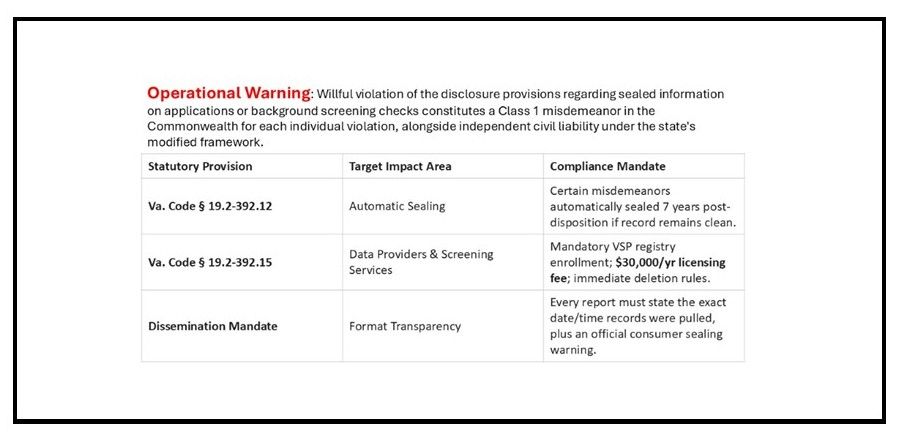
On July 1, 2026, Virginia’s expanded criminal record-sealing framework (Va. Code Ann. § 19.2-392.12 et seq.) officially takes effect. For the first time in the Commonwealth’s history, the law introduces automatic and petition-based sealing for actual criminal convictions—including specified misdemeanors (such as petit larceny, trespassing, and marijuana possession) seven years post-offense, alongside certain low-level non-violent felonies.
While the policy intent is to eliminate barriers for individuals seeking a second chance, the statutory mechanism written into Virginia Code § 19.2-392.15 imposes an aggressive, unprecedented operational and financial squeeze on any entity that sells, disseminates, or retrieves criminal history records.
If your business provides unadulterated court data to CRAs or litigation support clients, you are looking at a fundamentally altered—and highly litigious—Virginia landscape.
1. The $30,000 Pay-to-Play Registry Rule
The most shocking provision targeting data services is a mandatory registration and licensing framework managed by the Virginia State Police (VSP).
To legally disseminate criminal or traffic history data received on or after July 1, 2026, private background screening and data services must register with the VSP to receive electronic notifications of new sealing orders. The cost of entry? A staggering $30,000 annual licensing fee per account.
For the automated data factories that scrape bulk public files, this is a line-item expense. But for the independent court research networks, boutique retrieval firms, and regional specialists who provide direct courthouse verification, this exorbitant fee is a deliberate structural barrier. It fundamentally challenges the economics of localized, high-accuracy record retrieval.
2. Zero-Tolerance Deletion Rules & Civil Liability
Under the new statute, once a data service is notified of a sealing order, it must immediately delete the record. The law explicitly mandates that services promptly delete, and choose not to disseminate, any criminal or traffic record they know is sealed, regardless of the source.
Furthermore, the law explicitly bars background check providers from sharing sealed records under any circumstances. If a researcher pulls a physical file or prints an index that contains a newly sealed case, and that data passes down the chain to a CRA or employer, the provider faces direct exposure.
The statute opens the door wide to civil actions brought by affected individuals or the Virginia Attorney General’s Office for data services failing to maintain airtight "reasonable procedures" to ensure immediate records accuracy.
3. The Mandatory Timestamp Requirement
Even if you pay the $30,000 toll and maintain real-time syncing with VSP sealing orders, Virginia is imposing strict new formatting and disclosure mandates on the data stream itself.
When disseminating any Virginia criminal or traffic record obtained on or after the effective date, the provider must:
- Include the exact date and time when the record was originally received by the service.
- Provide a explicit statutory notice to the recipient warning that the information may include records that have since been sealed.
This requires immediate technical calibration of data delivery portals and API structures. For research firms operating on manual delivery, every single report format must be modified to prevent automatic non-compliance.
The Straightline Perspective: Why Systemic Filtering Destroys the Record
From a pure record-retrieval standpoint, the operational reality of "Clean Slate" laws reinforces a hard truth we have championed for decades: automated database scraping is an active compliance hazard.
When states attempt to scrub records across multi-tiered judicial databases, the latency between a judge signing a sealing order and the electronic pointer files updating is notoriously wide. A "clean" electronic pull may miss a file, while an outdated bulk database might illegally serve up a sealed conviction.
The introduction of these laws means that filtering data is no longer just an administrative task—it is a legal minefield. For professionals dedicated to providing unadulterated court information, the mandate to scrub and alter history before delivery fundamentally conflicts with the traditional definition of public record transparency.
As Virginia transitions to this phased, highly restrictive ecosystem, screening providers and researchers must recalibrate their adjudication rules immediately. If you have not paid the state's premium, restructured your report headers, and established an automated purge mechanism for Virginia files, July 1 is where the liability begins.
The Background Investigator will continue to monitor the roll-out of Virginia’s VSP registry portal and subsequent civil enforcement actions.