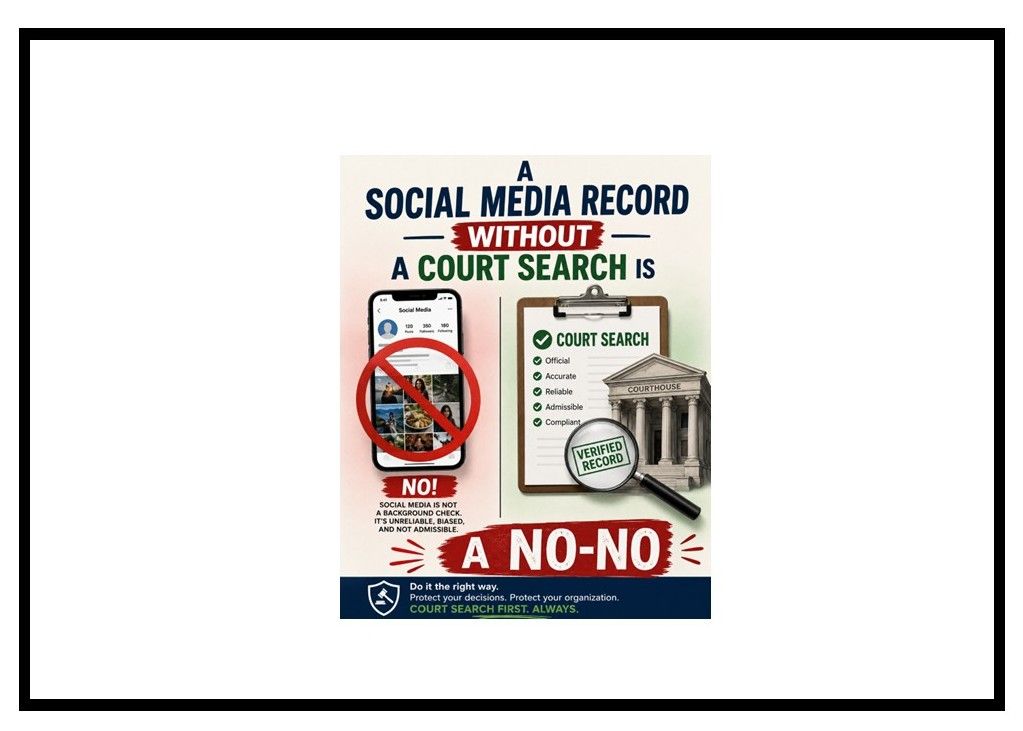
The lines between public court records and social media data are blurring in dangerous ways. In the background screening industry, this confusion isn't just a technical glitch—it's a liability nightmare for Consumer Reporting Agencies (CRAs) and an existential threat to job applicants.
The real danger occurs when a CRA mistakes a social media search result for a verified court record, or when a data wholesaler packages and sells social media scraps as legitimate court-sourced data.
Here is a breakdown of how this happens, why it happens, and the legal minefield it creates.
The Identity Crisis: Social Profile vs. Court File
A classic background check relies on primary source verification—visiting a courthouse, pulling a docket, and matching identifiers like dates of birth or driver's license numbers.
Social media screening, by contrast, relies on scraping algorithms that match names, locations, or photos. The systemic error happens when these two completely different pipelines cross.
Scenario A: The CRA Mistake
A CRA conducts a search and pulls a social media profile mentioning a local arrest or an online accusation. Because the person’s name matches the applicant, the CRA takes the internet post at face value and inputs it into the final background check report as an official "criminal history record," skipping the courthouse verification step entirely.
Scenario B: The Wholesaler Bait-and-Switch
Many CRAs buy their data from bulk record wholesalers. To cut costs and speed up turnaround times, some wholesalers mix scraped internet data, news articles, and social media mentions into their bulk "criminal databases." They sell this mixture to CRAs as "court record data." The CRA buys it, assumes it came from a clerk of courts, and passes the toxic data directly to the employer.
Why This Mix-Up Is Uniquely Toxic
When a social media scrap is dressed up as a court record, it strips away the basic legal protections built into the justice system.
- Zero Identity Safeguards: Social profiles rarely include full middle names, Social Security numbers, or dates of birth. Matching an applicant to a record based on a common name and a city is a recipe for mixing up completely different people.
- No Distinction Between Allegation and Conviction: On social media, an unverified rumor, a dismissed charge, or a piece of internet gossip looks identical to a formal conviction. When this data enters a background check as a "court record," a completely innocent person looks like a convicted felon.
- The Echo Chamber Effect: Once an error is sold by a wholesaler, it propagates. It gets bought by other databases, making the false record nearly impossible for an applicant to track down and completely erase.
The Legal and Compliance Fallout
Under the Fair Credit Reporting Act (FCRA), CRAs are legally required to follow "reasonable procedures to assure maximum possible accuracy" of the information they report.
Reporting a social media mention as a court record is a direct violation of this mandate.
FCRA Compliance Risk: Section 607(b) requires strict accuracy. Passing off internet scraping as an official court record opens up CRAs to massive class-action lawsuits, federal regulatory fines, and permanent brand damage.
Furthermore, employers who use these flawed reports run afoul of Equal Employment Opportunity Commission (EEOC) guidelines regarding the use of arrest records and social media data in hiring decisions, dragging the employer into the legal crosshairs alongside the CRA.
Protecting the Pipeline
To prevent this systemic failure, CRAs must enforce strict separation between data types:
- Strict Source Labeling: Every piece of data from a wholesaler must have a transparent chain of custody. If the primary source is not a county, state, or federal court clerk, it cannot be labeled or reported as a court record.
- Human Quality Control: Any match generated by automated bulk databases or social screening tools must be manually verified against actual court dockets before it is placed on a consumer report.
- Wholesaler Audits: CRAs must audit their data providers to ensure they aren't secretly blending cheap internet scraps into their premium court record feeds.
In the screening industry, accuracy isn't just a metric—it's someone's livelihood. Treating the lawless expanse of social media like a verified hall of justice is a risk no CRA can afford to take.